
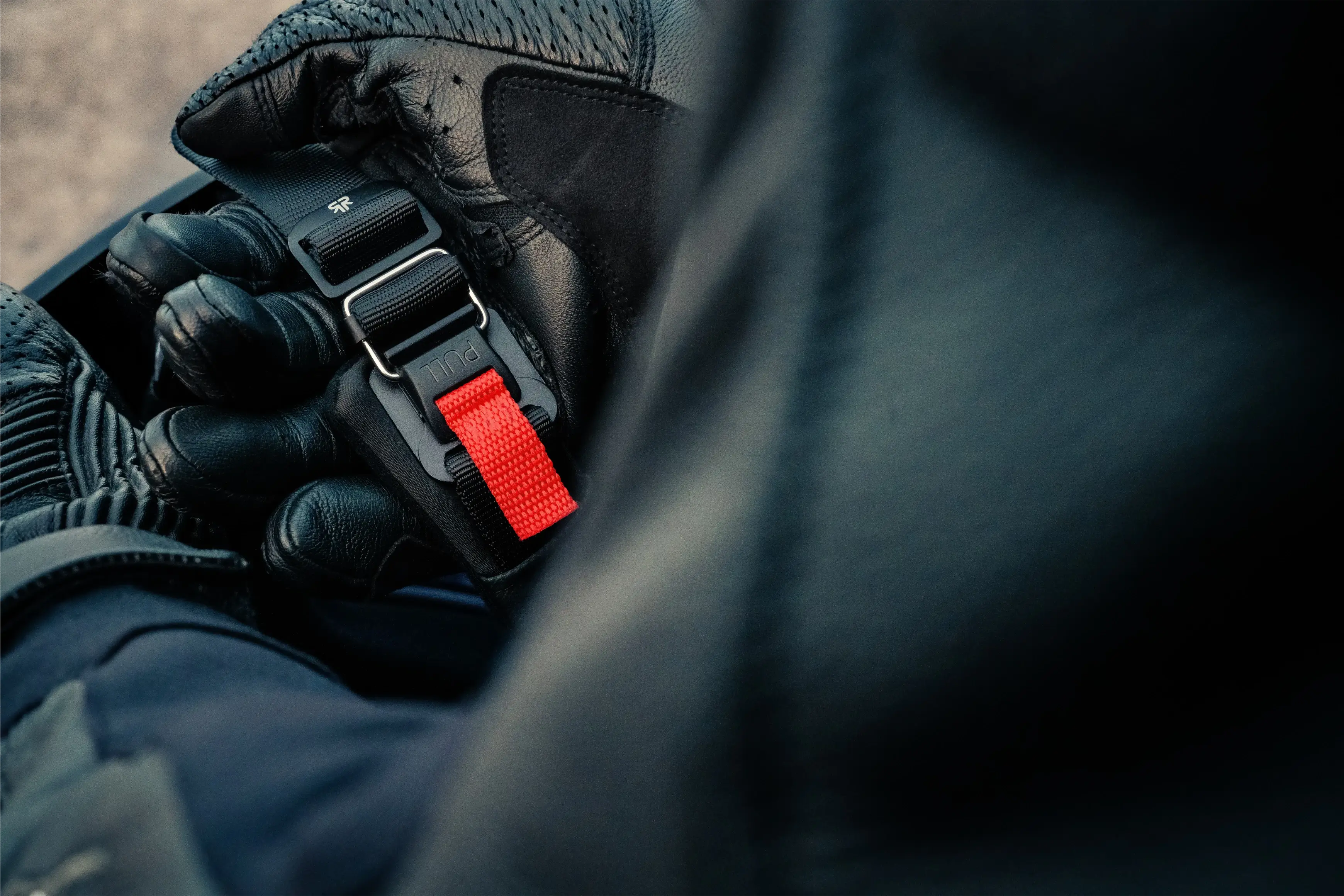
Magnetically Assisted Mechanical Fastening
If you've spent any time around modern motorcycle helmets, you'll be familiar with D-rings and ratchets. So when you see a Fidlock mechanism for the first time, your reaction will likely be either: "This thing is genius." Or: "Wait... a magnet is holding your helmet on?!"
First things first: NO, your helmet isn't being held together by fridge magnet technology. Fidlock is a precision-engineered mechanical fastening system that uses magnets simply to guide the buckle into place quickly and easily. The real security comes from the locking mechanism itself.
So let's clear up the confusion, explain how it works, and talk about why riders love it.

So, What Is Fidlock?
Fidlock is a magnetically assisted mechanical chin strap fastener. The important bit there is the mechanical part.
The magnets help align the two parts of the buckle together. It's quick and intuitive to fasten (especially with gloves on) but, once connected, the system locks mechanically into place and can only be released with a deliberate motion.
In simple terms:
- The magnets help it close quickly
- The locking mechanism keeps it secure
That means you get the convenience of a fast magnetic connection, without sacrificing safety or security.
The magnets help it close. The lock keeps it shut.
Fidlock is not exclusive to Ruroc. It is used globally on action helmets and accessories. If you're familiar with Troy Lee Designs and 100Percent from the motocross world, you will have seen Fidlock used on their high-end mountain bike helmets. And we use two varieties of Fidlock mechanisms on our motorbike and snow sports helmets.
Wait... So The Magnet Isn't Doing The Heavy Lifting?
Correct. This is the bit that tends to confuse people.
The magnets are there to guide the buckle together quickly and consistently. Once connected, the mechanical locking system is what actually secures the helmet.
Think of the magnets as the helpful assistant, not the bodyguard. The mechanical alloy buckle can only come apart by pulling the red tab. It does not slide, catch or twist open. It's one way or no way.

Why Riders Love Fidlock
Traditional double D-ring systems have been around forever, and for good reason; they work.
But trying to thread a D-ring while wearing winter gloves, in the rain, while your mates are already halfway down the road... isn't exactly the highlight of riding.
And you'll know from those times you accidentally left your house on your bike and realised that you forgot to do up your helmet, there's no way you're sorting that while riding.
Fidlock's big advantage is ease of use. The buckle snaps together quickly and can be opened with one hand, even while wearing gloves. No awkward two-handed threading, and no fumbling around at petrol stations pretending you know what you're doing.
Once adjusted correctly, it doesn't gradually loosen or tighten over time. The first time you buy a helmet with Fidlock is the last time you'll have to adjust the straps, and it won't shift mid-ride either.
To be unrestricting, almost unnoticeable, is probably the most underrated quality of excellent riding gear.
Is Fidlock Safe?
Short answer: yes. Long answer: very.
Fidlock fasteners used on motorcycle helmets meet recognised motorcycle safety standards including ECE 22.06 and DOT requirements.
At Ruroc, we've also spent years putting Fidlock systems through real-world and lab testing, because if there's one thing riders love almost as much as motorcycles, it's being sceptical about new technology.
We've tested Fidlock extensively across multiple helmet generations and we continue to use it across our motorcycle and snow ranges because we trust the system completely.
Fidlock vs Double D-Ring
This is usually where the internet starts arguing. The truth is: both systems work.
Double D-rings are simple, proven and widely used across the industry. We still use this system on our AT4 STREET range and our AT4 TRACK helmets.
Fidlock simply offers a different riding experience, one focused more on convenience, speed and ease of use without compromising safety. That's why we like it on our AT4 CARBON, EOX and EOX 2.0.
DOUBLE D-RING
Simple, proven and used industry-wide for decades. Threads through two metal rings and is held in place by friction once tightened. Requires two hands and a bit of patience, especially in winter gloves.
FIDLOCKMagnet Assisted
Magnets guide the buckle into place and a mechanical lock secures it. Quick to fasten, one-handed to release, and consistent every time you put the helmet on.


Some riders prefer the traditional feel of a D-ring. Others try Fidlock once and never want to go back. That's why at Ruroc, we offer both depending on the helmet and riding application.
Why Ruroc Uses Fidlock
We've worked with Fidlock technology since the early AT1.0 days, and it's now featured across multiple Ruroc helmets including the EOX, EOX 2.0, AT4.0 CARBON and our snow sports range.
For us, it comes down to these main reasons:
- Ease of use
- Reliability and safety
- Durability
- Rider experience
Because great helmet technology shouldn't just protect you, it should also make riding feel easier. And let's be honest, putting on riding gear is enough aggro as it is.
You'll find Fidlock on:
Is It The Future Of Helmet Fastening?
Maybe.
Helmet technology has evolved massively over the years. Better shells. Better liners. Better aerodynamics. Better comms integration. Fastening systems will evolve too.
Fidlock isn't about reinventing safety standards. It's about improving the everyday rider experience in a way that feels modern, intuitive and practical, without compromising on the safety that we prioritise above all else.
Once you've used one properly, going back can feel a bit like using wired headphones in 2026.
Watch Our Fidlock Testing Video
Still sceptical? Fair enough.
We put Fidlock through extensive testing and real-world abuse in our full video, which includes engineering breakdowns in an interview with the experts behind Fidlock.
FAQs
Is a Fidlock helmet held on by a magnet?
No. The magnets only guide the two halves of the buckle together. Once connected, a mechanical lock holds the strap in place. The buckle can only be released by deliberately pulling the red tab.
Is Fidlock safe for motorcycle helmets?
Yes. Fidlock fasteners used on motorcycle helmets meet recognised motorcycle safety standards including ECE 22.06 and DOT requirements, and we test them extensively across every Ruroc helmet generation.
Which Ruroc helmets use Fidlock?
Fidlock is featured on the AT4.0 CARBON, EOX, EOX 2.0, and our snow sports range. Our AT4 STREET and AT4 TRACK helmets use a traditional double D-ring system.
Can I open a Fidlock buckle with gloves on?
Yes, easily. Fidlock is designed for one-handed operation and works just as well with summer or winter gloves. That's a big part of why riders prefer it.
Fidlock vs Double D-ring: which is better?
Both are safe and certified. Double D-rings are simple, proven and used industry-wide. Fidlock is faster to use, one-handed and more consistent every time. Ruroc uses both, depending on the helmet model and riding application.
Will the magnets stick to other metal items?
The magnets are precisely engineered to align the two buckle halves and aren't strong enough to be a problem in normal use. They guide the buckle together, they don't do the holding.
Does the Fidlock strap loosen over time?
No. Once it's set to your fit, Fidlock doesn't gradually loosen or tighten ride to ride. You set the length once and don't need to keep adjusting it.